
It had been a few years since I had taught EAP to undergrads when I arrived here at the Shandong University of Finance and Economics last Spring. I was astounded with the degree to which GenAI tools were being used in my classes. Not just for writing essays or emails, as I would have expected, but it was even being used to generate responses to elicitation questions and tasks, and other communicative activities focusing on the production of spontaneous speech. This made it challenging to teach to the point of need, as it was hard to identify what the needs actually were.
I didn’t want to outright ban GenAI tools in my classroom, but I wasn’t sure what to do to keep the use of AI productive and in the service of learning. So when I came across the AI Assessment Scale on LinkedIn(!), I decided to experiment with it this semester. I liked the scale’s clarity and simplicity.
The Artificial Intelligence Assessment Scale (AIAS)
Perkins et al. (2024) propose the Artificial Intelligence Assessment Scale (AIAS) as a “a practical, simple, and sufficiently comprehensive tool to allow for the integration of GenAI tools into educational assessment [in higher education]”. In addition to offering “greater clarity and transparency” for both students and educators in the assessment process and being a “fair and equitable policy tool” for institutions, Perkins et al. (2024) claim the AIAS “offers a nuanced approach which embraces the opportunities of GenAI while recognising that there are instances where such tools may not be pedagogically appropriate or necessary”.
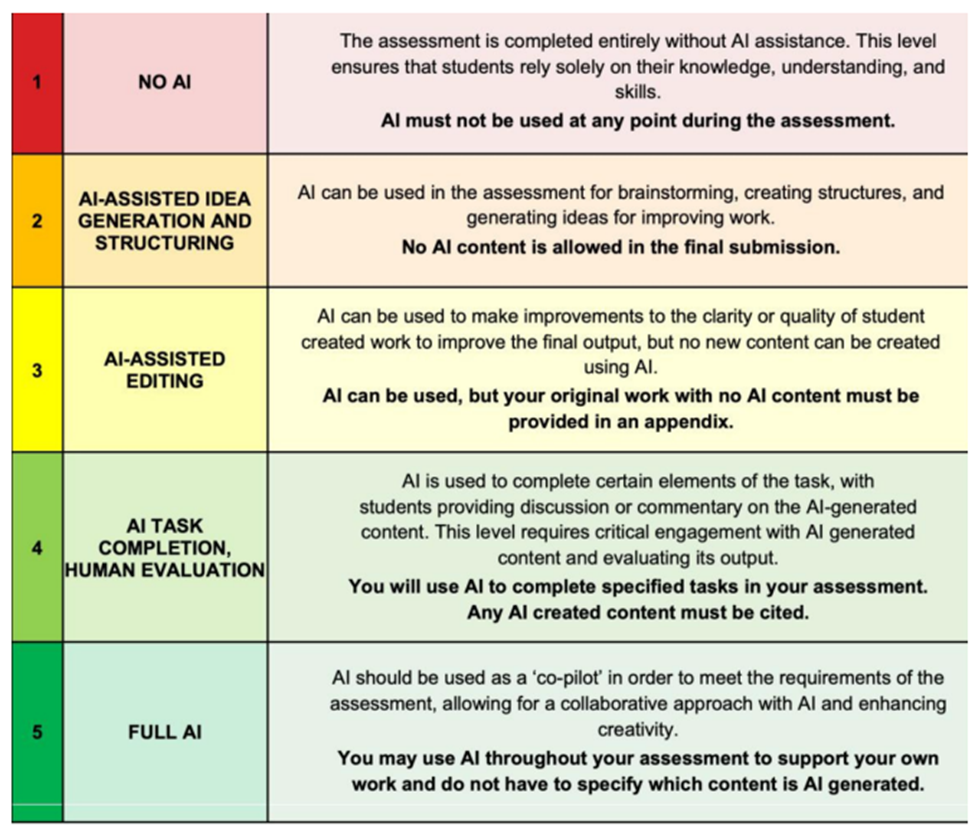
The scale consists of five types of permitted GenAI engagement in assessment, Level 1 on the scale is “No AI”, with Level 2 moving up to AI being used for idea and structure generation. Level 3 encompasses AI assistance for editing of student-created content, and Level 4 allows for “AI Task Completion, Human Evaluation”. The fifth level on the scale is “Full AI”. Each level on the scale is cumulative and encompasses the type of engagement on the scale below it. Each level on the scale addresses different types of learning outcomes.
The scale is made for teaching and learning in higher ed in general, but is easily applicable to the language education context.
The AIAS in my EAP Classes
With my classes, I have introduced the scale, grading the language in the descriptors down to approximately a B1 level and adding examples more appropriate to the Chinese university English for Academic Purposes context. I also developed a short activity where students read about 4 different scenarios where AI was being used to complete a task or assessment, and had to match it to the corresponding level on the AIAS.
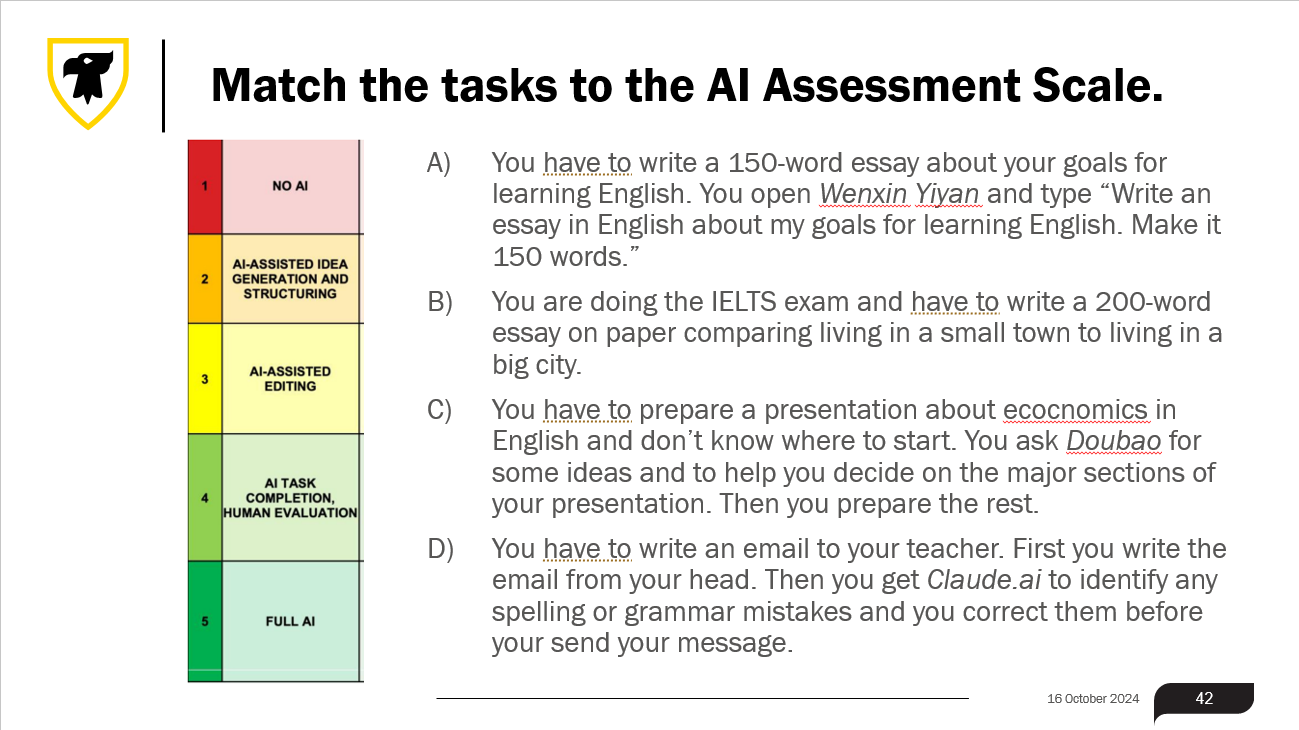
In all my classes this semester, each assignment or assessment task has a level and colour on the AIAS assigned to it. I’ve even started indicating which level on the scale is allowed for some in-class learning activities as well.
So far, students have responded well to the scale and many (though not all) assignments submitted adhere to the guidelines. This is a work in progress, so I’ll have to write a Part 2 of this post with a more fulsome description of how things went using the AIAS once the semester is over.
Updates to the AIAS
As well, after I’d already introduced the scale to my classes, I discovered there is a more recent update to not only the levels on the scale, but the colour scheme. It’s also already been adapted more specifically for the EAP teaching context! I’ll take these into consideration next semester.

 Dr. Jennifer J. MacDonald
Leave a reply to The AIAS and the Power of the Red Light – Dr. Jennifer J. MacDonald Cancel reply