
Back in October I wrote about my experimentation with the Academic Integrity Assessment Scale (Perkins et al., 2024) in the Chinese university English teaching context. I think it’s a great tool, and continue to use it in my teaching this semester with undergraduates and graduate students in language classes as well as a CLIL-based course in intercultural communication.
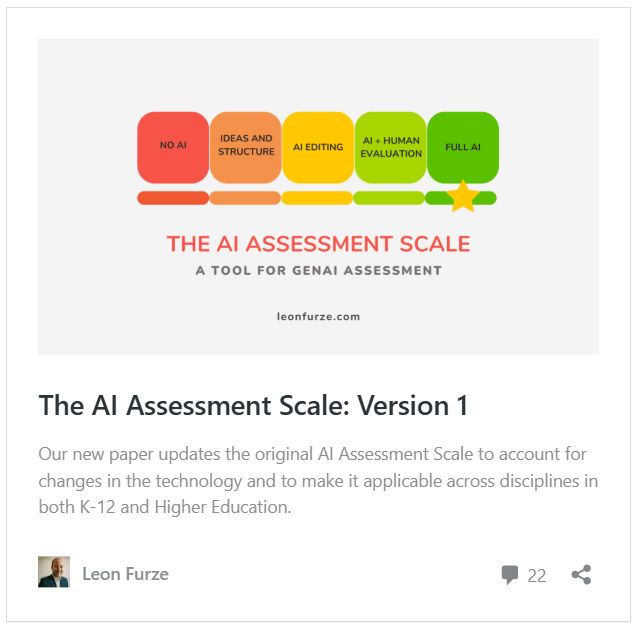
Last September, I started using Version 1 of the AIAS, which consisted of the “stop light colours” of red, various shades of yellow/amber, and green.
The researchers behind the scale have adopted a new colour scheme for Version 2 of the scale: what they’re calling “bubble gum colours”.
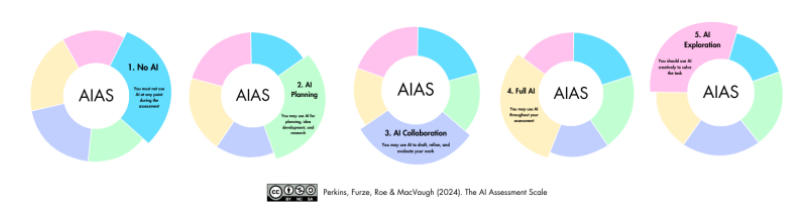
In an informative blog post, Leon Furze explains the rationale for this colour scheme change. Wanting to do away with the implied hierarchy of skills and/or ways of using AI associated with a red-yellow-green classification makes perfect sense, both conceptually as well as practically.
(It makes even more sense taking into account that in some traffic settings, yellow doesn’t mean “proceed with caution”, but rather “gun it as fast as you can to get through before the light turns red”, lol.)
But I do think the stoplight colours, especially red, can be useful, especially in certain learning contexts, like the one I’m teaching in at the moment.
The Power of the Stop Light
This semester I am teaching 200 first-year undergraduate students. Their English levels range from A2-B2, and I teach them in classes of 43-49 students. This is an English for academic purposes (EAP) course context.
Although in general they have very strong skills in other areas, such as test-taking and vocabulary, most of these students have not had the opportunity to develop critical skills related to using AI for learning purposes. They’re in the process of developing autonomy as learners and critical thinking skills as they come out of a very structured and directed high school environment. After years in an accuracy-focused language learning environment, many are now also becoming more comfortable with the concept of learning by making mistakes.
For all of these reasons, many students default to AI use on even the most straightforward classroom activities and assessments focusing on productive skills.
So I’ve found an important initial distinction is developing the skill of knowing knowing when AI is permitted, and when it’s not. In other words, if we should be using AI for a given task. For this, the red colour associated with Level 1 – No AI very clearly communicates what the appropriate use of AI is: i.e. if you’re thinking of using an AI tool, stop and try to complete the task using your existing skills and knowledge.
As well, with learners who use English at lower levels of English language proficiency, it’s important to be very clear in terms of instructions and other teacher talk and we often rely on non-verbal communication to complement our verbal instructions. The colour red has powerful associations that even low-level users of English can understand.
Later, we’ll move onto the distinctions of how to use AI, and for this levels 2-5 on the AIAS will be useful as we explore different ways AI can be used, and develop the skills that correlate with them. But for now, we’re working on the basic skills.
AIAS Version 2 with Primary Colours?
So while I have introduced Version 2 of the AIAS with its bubble-gum colours to my upper-year and graduate students, I continue to use Version 1 with first-year undergrads.
But perhaps an alternative version of Version 2 could be developed, maybe keeping red for Level 1, but with other primary colours for the other levels? This would take advantage of the advantages of the colour red, but avoid the pitfalls associated with yellow and green.
 Dr. Jennifer J. MacDonald
Leave a comment