
I’ve started learning Mandarin Chinese and as I mentioned in my review of the Rocket Languages app, I’m building a repertoire of language learning tools to support my self-study.
I went to Coursera to add a more traditional course (albeit a MOOC, or massive open online course) to my toolkit, and amongst the dozens of Chinese language courses on the platform chose a “speaking” course called Chinese for Beginners offered by Peking University. (Peking University is China’s #2-ranked university and I do admit that this caught my eye.) This course is fully asynchronous and self-guided, and they say it takes 23 hours to complete.
It’s a pretty typical asynchronous online course, in my opinion. The course consists of 7 units, each with a series of “lectures” (short videos), “readings” (what they call any type of text-based input) and multiple choice/short-answer quizzes. You have to pass the quizzes with 60% in order to pass the course, and there are restrictions on how many times you can retake quizzes per day, etc. There are also three, ungraded “Immersive Experiences”. The topics are your typical, beginner’s, everyday topics: family, food, colours, shopping, introductions, etc.
They say it’s a “speaking” course, and the reason I’ve put quotes around “speaking” is that it doesn’t evaluate speaking in any way. In terms of teaching speaking, other than asking you to “repeat this word/phrase with a friend”, it’s only in the Immersive Experience that you get a chance to practice speaking. I’m assuming by calling it a “speaking” course they just mean that it’s fully based on pinyin and doesn’t attempt to teach any Chinese characters. Which is fine for me at this time. Peking University has various other courses on Coursera teaching Chinese characters so maybe I’ll do one of them in the future.
[Screenshots included below.]
What I like about the course is the Coursera interface, which is clear, well-organized and intuitive. I also like the fact that the content is broken down into small chunks (some units smaller than others) with a short quiz to test your knowledge right away. I enjoy Rocket Languages, but the modules and assessments do tend to include a lot of content, and so this is easier to handle.


I also really enjoyed the Immersive Experiences, which you can do on a desktop or using a VR headset. You enter a digital version of Wangfujing Market in Beijing, and navigate around the market carrying out various challenges: a scavenger hunt, ordering food, and carrying out a conversation. Each of these activities corresponds with the content of the unit in which it’s embedded. As part of the immersive experience, you have to listen and repeat words or phrases, and it evaluates your pronunciation, (though the criteria for evaluation are unclear).
Now look, I’m not a gamer AT ALL, but the I found these kind of fun! The navigation is a bit wonky on desktop, but I enjoyed the interactivity and the task-based nature of these activities.
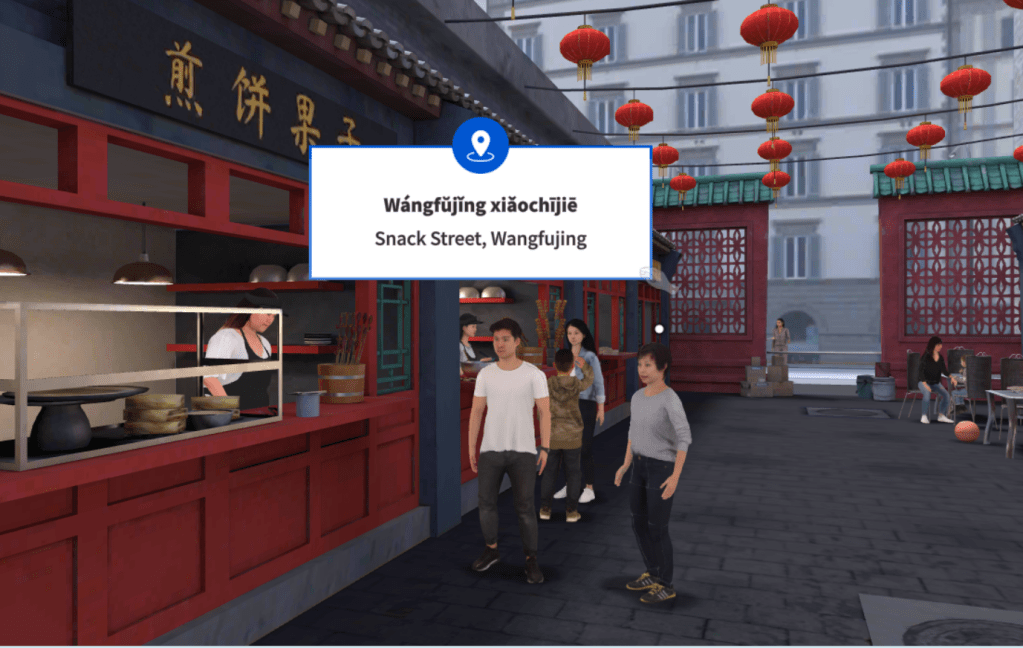
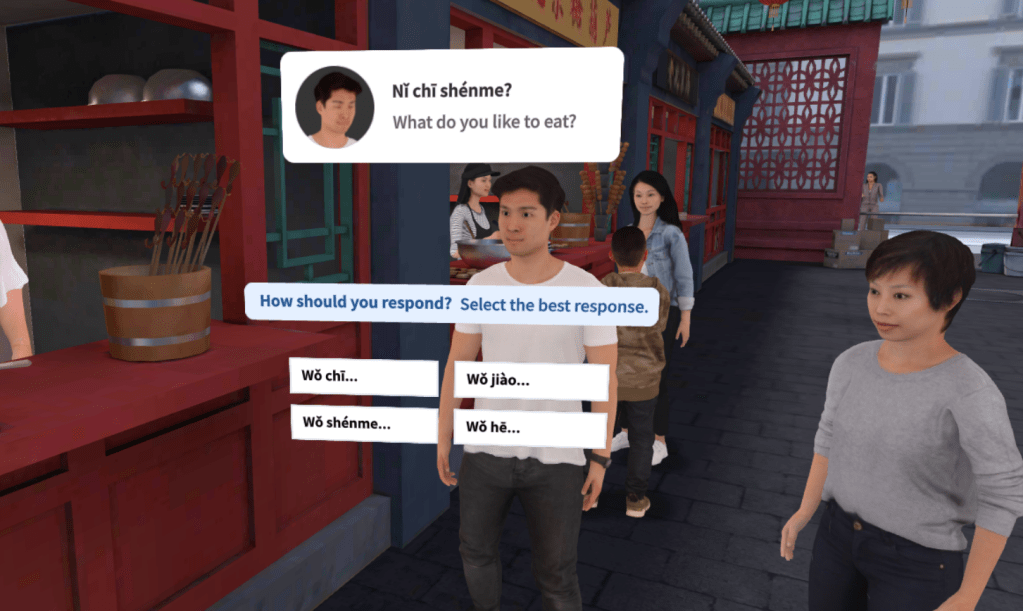
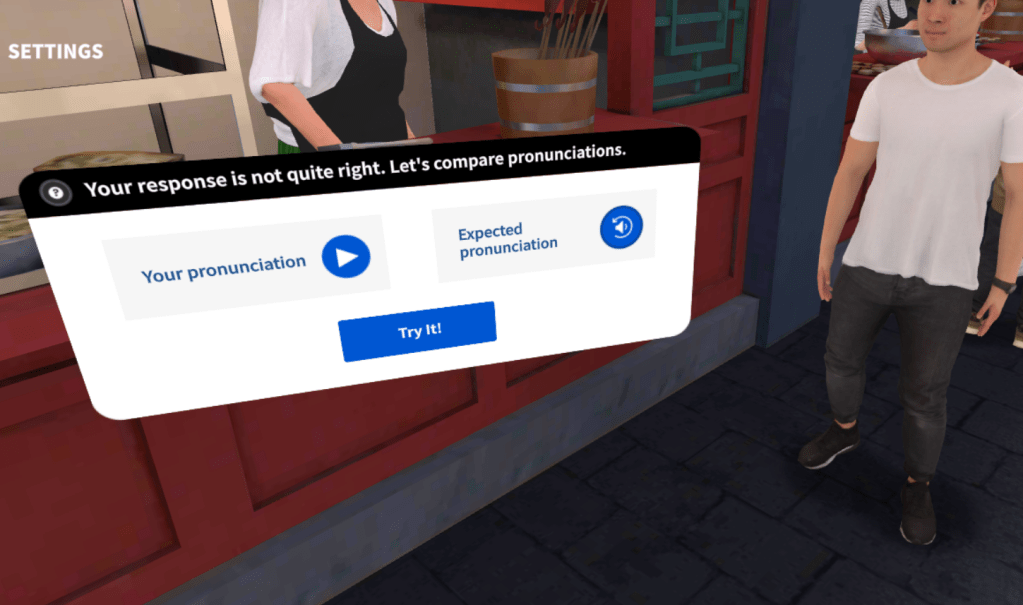
There are several areas small improvements that could be made in this course. The first would be human revision of the transcriptions for the videos, which seem to be machine transcribed. Anything that’s not English, it just marks with [FOREIGN], which means that all the content of what you actually want to learn doesn’t appear in the transcripts, making them useless. Given this, it would be great if each unit had a downloadable document summarizing the content (vocabulary, grammar, etc.) for each unit.
There are Extended Practice “exercises” throughout the units. But all they are are text-based grammar translation style lists of sentences to translate, or asking you what you’d respond to something, etc. But there’s nowhere to actually write any of these answers down within the course. It’d be great if they fully digitized these Extended Practice exercises and make them unmarked quizzes, where you can enter your text and submit and then it will show you the correct answer to compare with your text entered.
There are also some pacing and sequencing issues in the first unit. They’re trying to teach you the pronunciation rules of Pinyin, tones and some vocabulary all at the same time, and it really jumps around a lot. I think it would be better to keep the pronunciation content separate from the other content in unit 1, perhaps in a preliminary unit or something.
This isn’t a course that’s going to revolutionize Chinese language learning. 🙂 It is what it is: an asynchronous course that is on the whole not very interactive and teaches/evaluates knowledge rather than skill. You get what you pay for! But I personally enjoy a little grammar translation in my life. And as someone comfortable with self-led language learning, I find it a nice addition to my repertoire of tools.

 Dr. Jennifer J. MacDonald
Leave a comment