
When I found out I was going to spend some time in China as a Visiting Lecturer at the Shandong University of Finance and Economics, I knew I wanted to start learning Mandarin.
As a linguist and language teacher, I admit I’m very picky about my language learning experiences: I know how I like to learn. I also really like autonomous learning, and am very comfortable assembling my own repertoire of language learning tools and supports. In this case, for various reasons I didn’t opt for including a formal course or a private teacher in my repertoire of tools, though I’d like to do this down the road. (I’m currently looking at a few free courses on Coursera and would love to find a good teacher.) Instead, I wanted the flexibility and asynchronous modality of an app.
Of course, I started with Duolingo, which I’d dabbled with in the past for languages I was also starting from scratch. But Duolingo, despite its brilliant marketing team, very slick interface and design, and top-notch gamification, doesn’t really work for me as a language learner–I’ve written about it and some other apps before. (And we’re not even talking about the equity concerns associated with Duolingo and other platforms). And now it’s gotten to the point where the number, frequency and intrusiveness of ads in the free version of the app makes it practically unusable.
So this time I chose Rocket Languages (which I can access for free using my Halifax Libraries card! Public libraries, FTW!!!). And I am enjoying it!
[Screenshots of the app are in the Slideshow below.]
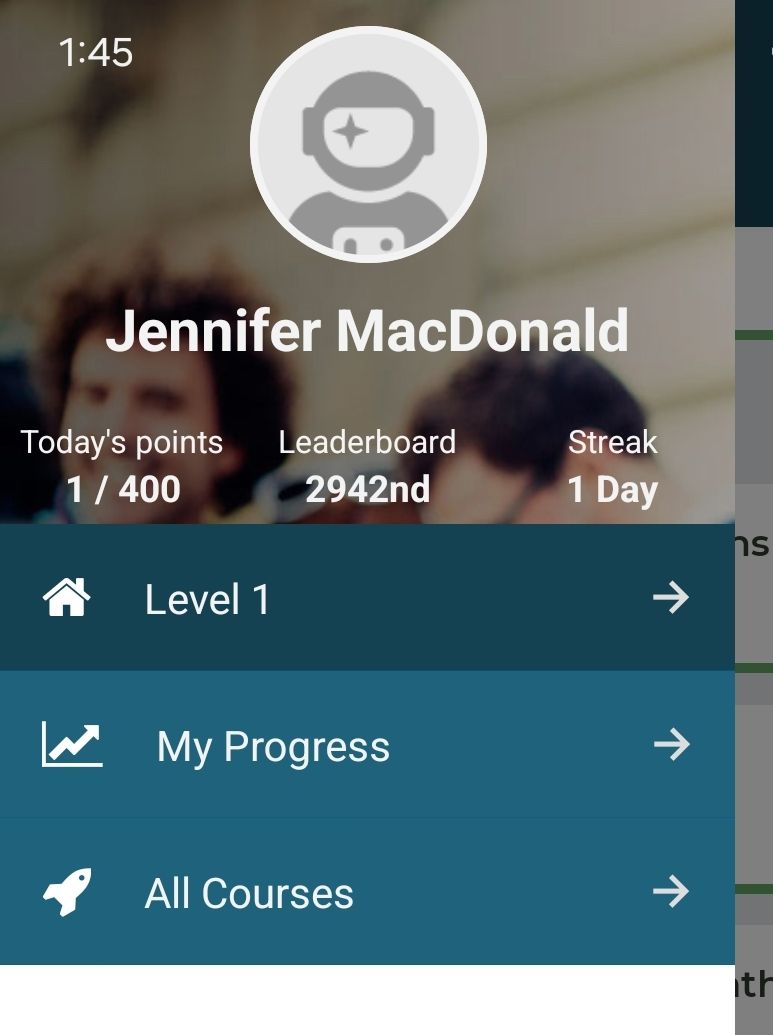
The interface is a bit plain, though things are linearly organized and numbered. It does have some elements of gamification, such as a Leaderboard, and letting you calculate your “streak” of consecutive days where you’ve used the app. I honestly don’t care about gamification at all, and don’t find it motivates me, but of course YMMV.
Each Module has 3-4 hours of content, consisting of Audio Lessons, Language and Culture Lessons, as well as Writing Lessons (which focus on writing Chinese characters, as the rest of the course is in Pinyin.) The main reason I don’t find Duolingo useful is the lack of explanations of anything–I’m the type of learner that doesn’t do well with rote learning, as I want to understand how things work. And this app certainly satisfies my need for explanations, with ample notes on grammar, vocabulary, writing, as well as culture.
The other main shortcoming of Duolingo for me is the lack of consideration of any principle of frequency or utility in terms of the vocabulary and structures presented. (Hence the not useful or sometimes downright absurd Shit Duolingo Says). Rocket Languages, on the other hand, is seemingly built around common situations for travellers or people who may be visiting China for work or study. So this was quite helpful for me, as I was learning the vocabulary and phrases that I would actually encounter in my day-to-day life in China.


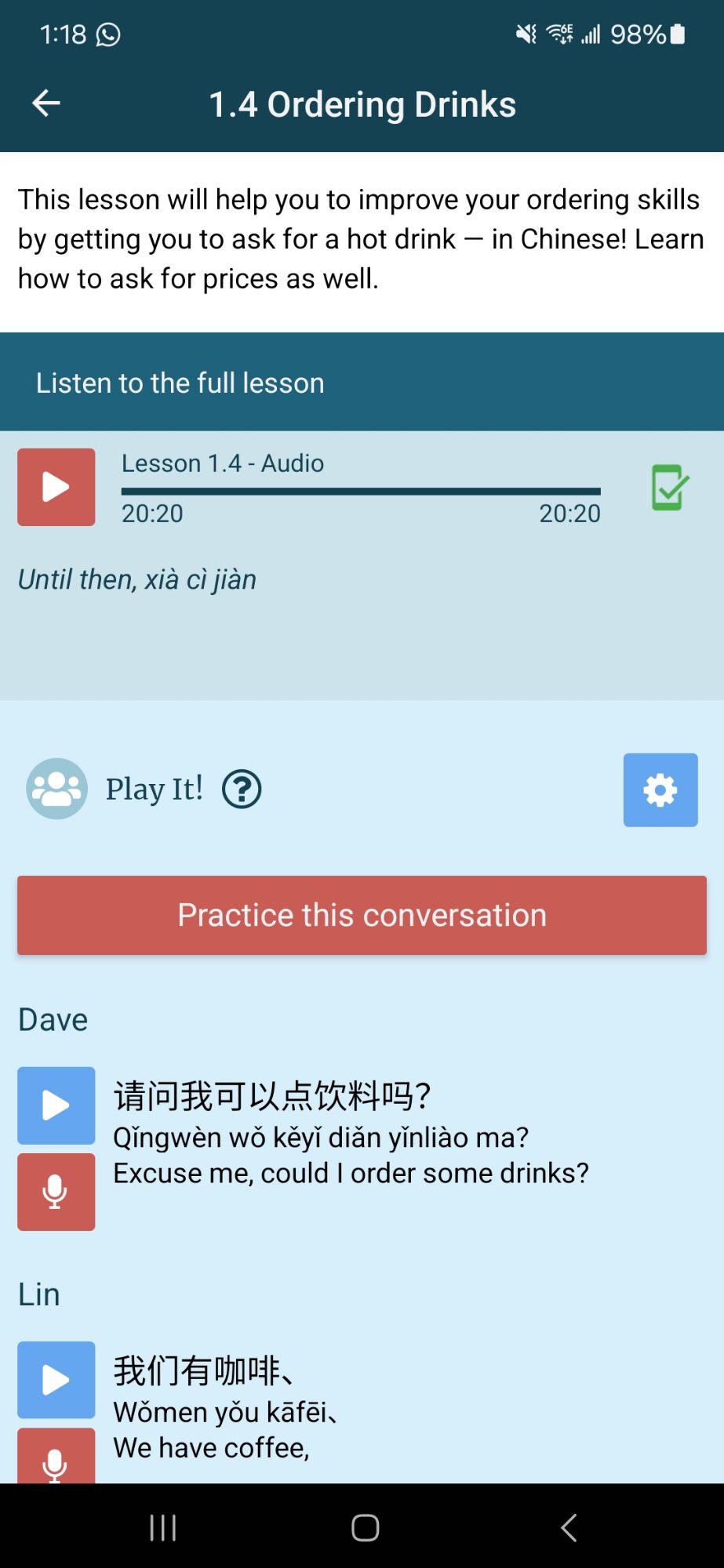

The Language and Culture Lessons are text-based, though interspersed with audio excerpts and also ample explanations of whatever phenomenon is being presented. The Audio Lessons consist of a 20-30 minute audio recording, which is downloadable and can be played offline. The main elements of the dialogue are then broken down outside of the recording so you can listen to and repeat each phrase individually. There are also Writing Lessons, which introduce Chinese characters in a logical way, based on common radicals, and linking the writing to the pronunciation and pinyin.
There’s a feature listens to and gives you a percentage rating on your pronunciation. It’s not bad–better than some other apps (such as Duolingo), but still with some shortcomings, such as clarity of what aspects of pronunciation it’s actually rating. For example, in the case of Mandarin, is it rating your tones, or just the vowel and consonant quality? Or something else?
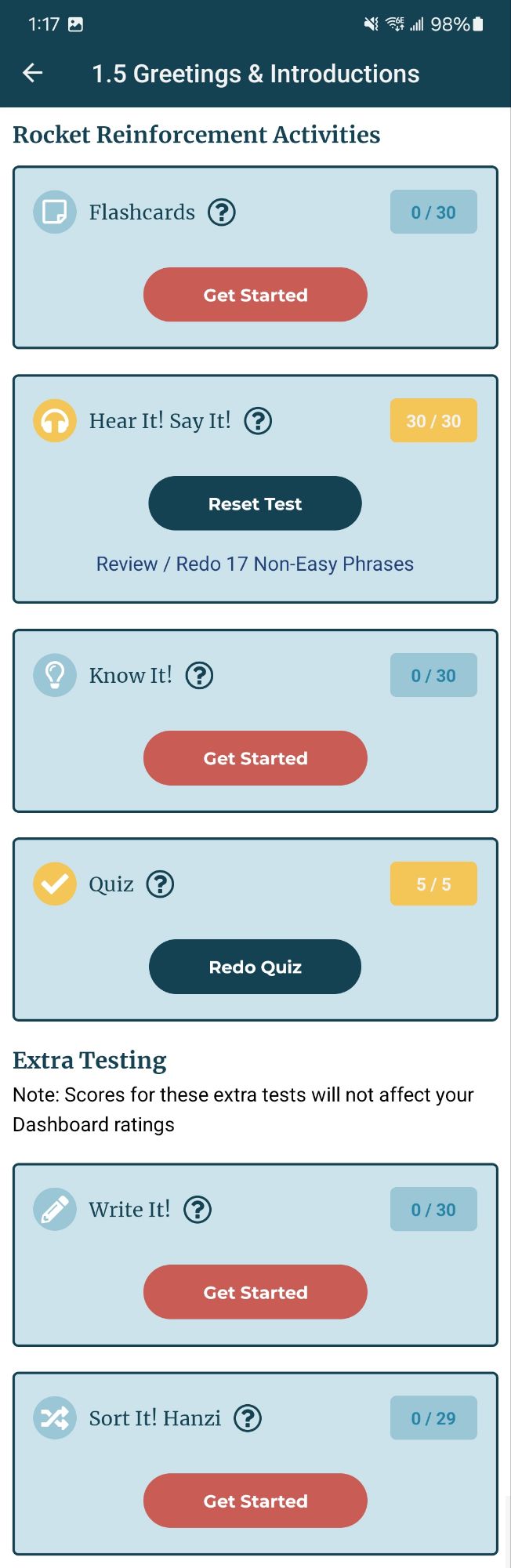
Each lesson has a variety of what it calls Reinforcement Activities, which are flashcard, multiple choice quizzes, and text and audio-based grammar translation activities. (Which is nothing revolutionary, but I do enjoy, because I love me some grammar translation.) One thing I like about some of the exercises is that you can self-rate each question as whether you found it easy, good or hard, and then the apps gives you the option to easily go back and just repeat what was not easy for you.
Of course where most apps fall short is opportunities for the learner to develop productive skills, fluency and communication strategies, etc., and Rocket Languages is no exception. I didn’t expect that from an app like this. For me what could improve the app would be the ability to use it offline. Right now, other than just listening to any audio lessons you’ve manually downloaded, you can’t use it offline, which makes it harder to incorporate into a daily subway commute or a plane journey.
Overall, I am enjoying Rocket Languages and it’s a solid part of my repertoire of tools to learn Mandarin.

 Dr. Jennifer J. MacDonald
Leave a comment