There comes a time in every EAP course, usually at the beginning, when you have to have THE TALK with your students–that awkward moment when you address the elephant in the room.
“That crap dictionary/translator you rely heavily upon is making you sound dumb.”
While a crappy bilingual dictionary or online translator can be sufficient for some beginning students, those who have reached intermediate level, and especially those heading into EAP, may be hindered by simplistic or inaccurate dictionaries.
And while dictionary skills are on the curriculum for some EAP courses, they sometimes still focus on paper dictionaries and/or don’t talk about dictionary choice and the limitations of a lot of the translation websites and apps many of our students end up using out of convenience. Many of our students don’t realize that the translator they use like a dictionary is probably machine-driven. For their routine lookups of words they’d be better off with dictionaries compiled by humans.
Below is a handout I prepared for my colleagues with some of my faves. Share yours with me in the comments (especially apps for iOS).
TEACHERS FRIENDS DON’T LET STUDENTS FRIENDS USE BAD DICTIONARIES
Encourage students to not just use Google or whatever random dictionary website/app they come across, but to choose a quality dictionary site or app that is associated with a published dictionary brand. This means it should be compiled by lexicographers (and not via an algorithm/crowd-sourcing).
Some recommendations:
English-English Dictionaries Online (Web-based)
Personal Fave: Oxford Advanced Learners’ Dictionary
- Learner-appropriate level, with simple definitions
- Usage notes, collocations, etc.
- Tabs on top of homepage have wordlists, and words groups by topic
- Free online via web; paid app (see below)
Also:
Cambridge Advanced Learner’s Dictionary
Collins: English Dictionary, Thesaurus
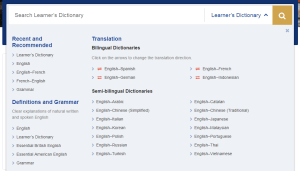
Bilingual dictionaries Online (Free, web-based)
Many students use Google translate to translate single words. That tool is a powerful one, but I don’t find it very accurate for single words. It mainly works based on algorithms and crowd-sourcing, and depends heavily on context, so it’s not as accurate as a “real” dictionary, especially for single words.
Collins Chinese , French, German, Italian, Spanish, , Hindi

Oxford Dictionaries Arabic (other languages are available, but by subscription only)
Apps
A lot of the good dictionaries and learner’s dictionaries are only available as paid apps. Despite pointing out to your students that $30 for an app they may use every day of their academic career is a good investment, they may balk at paying for one.
Search for the following in the iTunes/Android app stores:
Paid English-English Dictionary Apps:
Both platforms (iOS and Android):
- Cambridge Advanced Learner’s dictionary
- Oxford Advanced Learner’s Dictionary
- Oxford Advanced Learner’s Dictionary
Free English-English Dictionary apps
Android:
- Oxford Dictionary of English: Note this is not a learner’s dictionary, but the regular Oxford Dictionary
- Merriam-Webster Dictionary: Note this is not a learner’s dictionary, but the regular M-W dictionary
- Oxford Learner’s Thesaurus
Apple iOS:
Bilingual Dictionary Apps: Paid/Free/Free trial
Android:
- Oxford dictionaries: French, Spanish, Portuguese, Italian, Russian Greek, Thai, (all free)
- Collins dictionaries: Korean (free trial, ~$10), Arabic (free trial, ~$10), Japanese, German, Norwegian
Apple iOS:
- Oxford Dictionaries: French, Spanish, German, Italian Russian, Chinese, Portuguese, Japanese, Greek
- Cambridge Dictionaries: Chinese (paid)


 Dr. Jennifer J. MacDonald
Leave a comment