
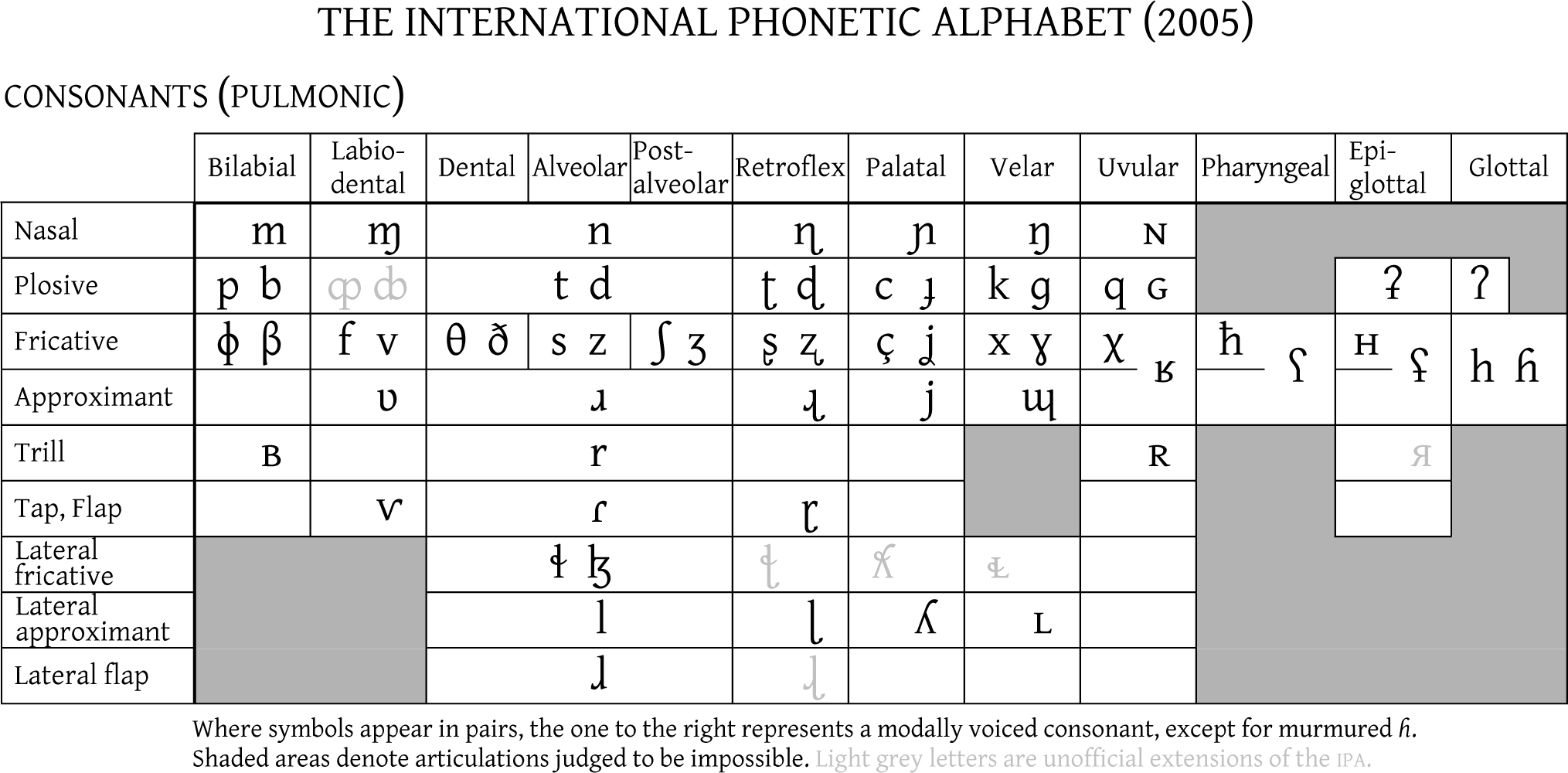
 IPA as in the International Phonetic Alphabet, and not India Pale Ale, to be clear. 🙂
I recently posed this question on Twitter, and got a variety of responses. Some agreed that it was helpful but not necessary, and others pointed out that knowing IPA is one thing, but knowing the phonology and phonetics that underlie it, and also knowing if/how to use it in class, is another.
I still think that any teacher worth their salt should know it, though. At least the IPA for the sounds of English. Here are my reasons, in no particular order.
- Credibility. Many of our students know it. (Especially those from certain countries in Asia). Many (though not all, of course) learner’s dictionaries use it. Isn’t there a lack of credibility if the teacher doesn’t know what seems to be a pretty common tool in ELT?
- Phonological awareness for teachers. In learning the IPA for the phonemes of English, one could assume the teacher has come to the realization of just how many phonemes there are in English, how some of the closer vowel phonemes, for example, resemble each other but are different, and how there is a discrepancy between the sound system and the writing system of English. It is not a given that someone will have gained this awareness simply by learning IPA, but I think you could assume this happens in many cases. This awareness is invaluable for teaching pronunciation and speaking. Our subject matter as English teachers is language, and it is our duty to deepen our knowledge not just of grammar and use, but of the sound system as well.
- Phonetic awareness for teachers. This one could be even less of a given that the point above, but if a teacher learns the descriptive name for each of the symbols (e.g.: /p/ voiceless bi-labial stop) they will hopefully gain awareness of the place and manner of articulation of the sounds of English, which is also important for the teaching of pronunciation.
- Precision in the classroom. Though the nuances on how and if to use IPA in the general English classroom are debated, it’s just a concise tool for raising students’ phonological and phonetic awareness. If English had a one-to-one grapheme to phoneme relationship, it wouldn’t be so necessary. But alas, IPA is just a concise way to break students’ habit of speaking English as it is spelled. I don’t know how you can take the teaching of pronunciation beyond “No, just say it more like ME!” if you don’t have the tools to precisely think about and describe the sounds of English. If you didn’t know the types of and names of verb tenses and how they were composed, it would be hard to teach grammar. Isn’t this the same thing?
- Cross-linguistic potential. This is a minor one, but since IPA is cross-linguistic, it can be a neat way to compare the sounds of English to your students’ L1 and talk about they ways they are similar and different. It’s also useful for writing down and correctly pronouncing your students’ names.
Any reasons I’ve missed? Do you think that IPA is a must for English teachers?
PS: I’m going to cheekily add that in my experience the people who I’ve had most insistently argue that knowing IPA isn’t necessary have not known it themselves. 🙂


 Dr. Jennifer J. MacDonald
Leave a comment